
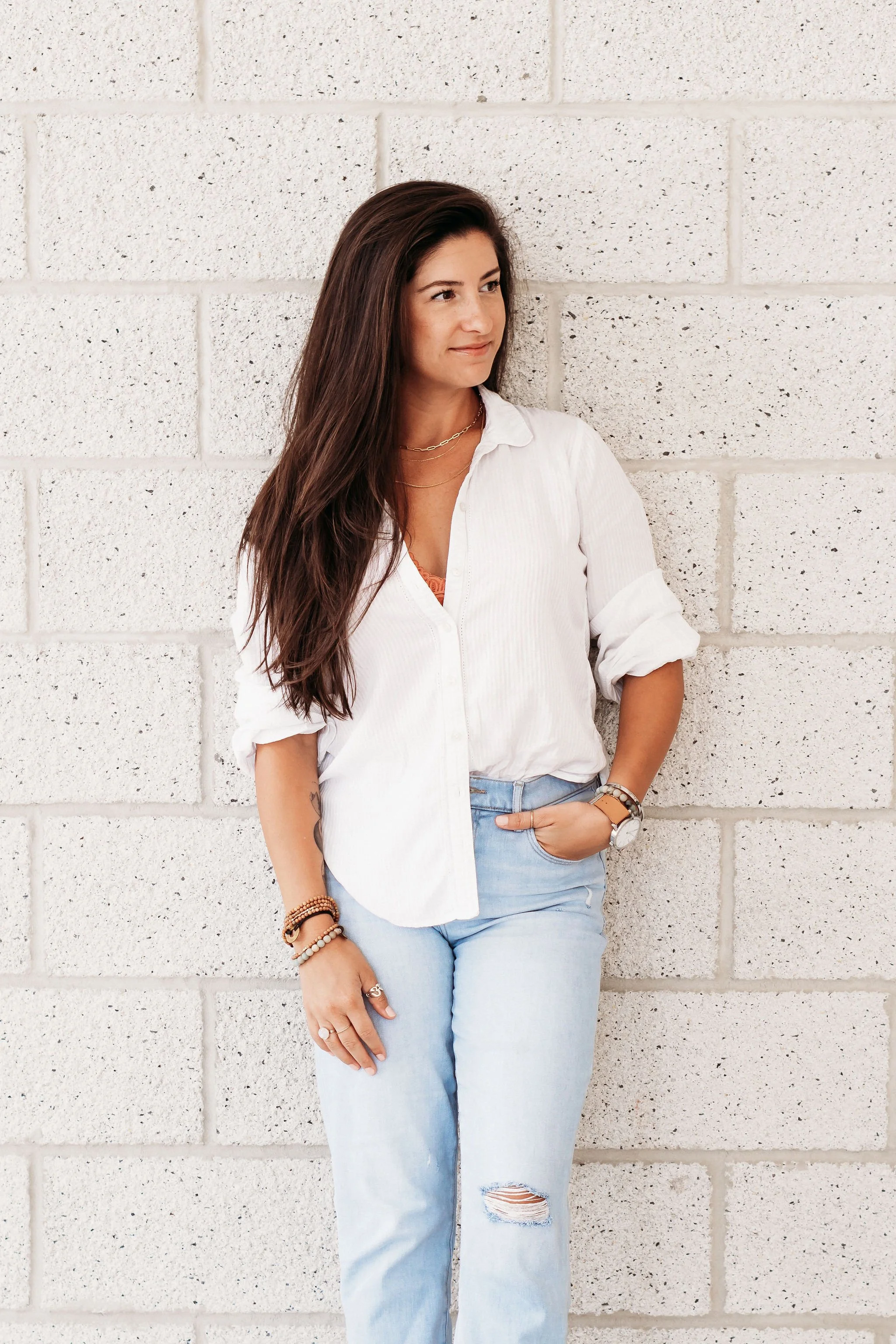
I was raised in Jupiter — a beach kid who grew up climbing trees, wake skating, and spending every possible moment outside. That connection to the natural world never left me, and I think it quietly shaped everything that came after.
My path to becoming an acupuncturist started with my own health. I was struggling with stomach issues that Western medicine couldn't resolve — and while I deeply respected conventional medicine, I kept feeling like there had to be something more.
Then, I found acupuncture. I entered with little hope but an open mind and much to my surprise within a few weeks, my pain and issues seemingly melted away. But, what surprised me the most was everything else that changed in the process: the stress I'd carried for years, the anxiety, the sleep struggles — things I'd assumed were just part of life — lifted in ways I hadn't anticipated. I was lying on the treatment table one day, mid-session, and with so much certainty decided I wanted to share this magic with the world. I applied to acupuncture school and never looked back.
What I discovered in school changed how I understood the female body entirely. I used to dread my period — the pain, the disruption, the way it knocked me out every month. Chinese medicine taught me to see it differently: as a report card, a check-in point, a signal that something is asking for attention. It made me realize that painful cycles, irregular hormones, the feeling of not being heard by your doctors — these aren't things you just have to live with. They're patterns that acupuncture and herbs can genuinely address.
The longer I've been in practice, the more I've come back to this truth: women are under-heard and underserved in medicine. I know that from my own experience, and I see it over and over again in my patients. Having a tool that can help — that can rebalance how the body is functioning so that a woman isn't fighting against her own body, can move through her fertility journey with more support, can actually feel well — that's the gift I get to give. I don't take it lightly.
My clinical training includes orthopedic acupuncture, which deepened my understanding of pain, how intricate our muscle system is, and the way the body works as an integrated unit. But the approach I fell most in love with is Japanese acupuncture — a gentle, minimalist style that uses finer needles and fewer points. The philosophy is that by quieting the signal rather than amplifying it, you allow the body to respond more profoundly. I experienced this in my own body as a patient, and it's the foundation of how I work with mine.
Japanese acupuncture also uses distinct diagnostic tools that let me see how the body is actually holding and storing what a patient is going through — not just what they're describing in words. That kind of listening, the kind that goes beyond what's said out loud, is at the heart of everything I do at Cypress.
I grew up on these streets. Cypress Drive has been around the corner from my childhood home for thirty-six years, before I ever imagined I'd one day open a practice here. I studied and lived in Massachusetts, and loved it — but the ocean called me back. Jupiter is where my soul belongs, and getting to give back to this community, in this specific spot, is something I genuinely can't believe I get to do.
Casey McCaig, AP, Dipl. OM
Credentials
Masters of Acupuncture and Oriental Medicine, New England School of Acupuncture/Massachusetts College of Pharmacy and Health Sciences (2022)
Bachelor of Arts in Humanities -The University of Central Florida (2012)
Certified Yoga Teacher - 200 hour YTT at the Sivananda Ashram in the Bahamas (2013)
Education
Licensed Acupuncture Physician (AP), State of Florida
Diplomate of Oriental Medicine (Dipl. OM) - NCCAOM Certified
Certified in Orthopedic and Japanese style acupuncture
Certified in injection therapy (2023)
Traditional Chinese medicine sees the body as a whole — never a collection of symptoms to be managed in isolation. Casey's approach is rooted in this systems-based thinking, using Japanese acupuncture's precise needling techniques alongside classical Oriental medicine diagnostics to identify patterns, not just problems. The goal isn't to mask what's happening — it's to understand why, and restore the conditions your body needs to do what it already knows how to do.